

1 min read
Your Tsunami Warning Update: Inundation and Landfall Has Arrived
Tsunami Warning Update: Inundation and Landfall Has Arrived The CRE Tsunami has now come ashore, causing valuations to decline significantly, demand...
2 min read
Ron McMahan
:
June 5, 2026
The phrase "extend and pretend" has become shorthand for everything happening in the CRE debt market right now. It's catchy, but it flattens a more complicated picture, and if you're a borrower or broker trying to understand where the real stress is building, the oversimplification matters.
A recent Trepp analysis breaks down why.
When a bank amends a loan with a principal paydown requirement, that's a different credit event than a CMBS loan sitting unresolved past maturity while still current on payments. Treating both as "hidden losses" misses the distinction between a lender deferring a problem and a lender managing a workout.
The bank data is telling: post-2022, weaker loans weren't getting easier terms — they were getting harder ones. Paydowns, added recourse, and wider spreads became more common, particularly for lower-quality borrowers. That looks less like loss concealment and more like disciplined credit management under pressure.
CMBS loans resolve more slowly by design. Securitized trust structures, servicing rules, and bondholder dynamics mean that a loan staying outstanding past maturity doesn't automatically signal distress. Trepp calls this "maturity drag" — a delayed resolution that may reflect refinancing complexity more than borrower failure.
The more useful signal isn't whether a loan is past maturity. It's whether it stays current while a resolution plays out, or starts missing payments as options narrow.
Debt service coverage ratio used to be the primary screen. It still matters, but debt yield — net operating income relative to loan balance — has become the more decisive factor. That shift makes sense in the current environment: the real question isn't whether a property can cover today's payments, it's whether the loan can actually refinance at today's rates and underwriting standards.
Low-debt-yield loans are where maturity stress concentrates. They have the least room to refinance without new equity, NOI improvement, or a principal paydown. That's where the wall is hardest to climb.
Where to watch
Office and legacy retail remain the highest-risk sectors — not because every loan is distressed, but because those asset types combine the most variables at once: pressured cash flow, uncertain valuations, capital needs, and limited refinancing options. A small number of large loans in those categories are driving most of the headline delinquency numbers.
The maturity picture is loan-specific and resolution-specific. Borrowers with strong debt yield and stabilized assets have real options — refinancing, negotiated extensions with reasonable terms, or bridge solutions while longer-term capital comes together. Those with weaker fundamentals are facing a narrower set of paths, and waiting for conditions to improve is becoming a less reliable strategy as extended loans from 2024–2025 pile into the 2026 window.
If your loan is approaching maturity and the conventional refinancing math doesn't work today, that's exactly the kind of situation FSF's bridge lending and creative financing structures are built for. The market is complex right now — but it's navigable with the right capital partner.
1 min read
Tsunami Warning Update: Inundation and Landfall Has Arrived The CRE Tsunami has now come ashore, causing valuations to decline significantly, demand...
1 min read
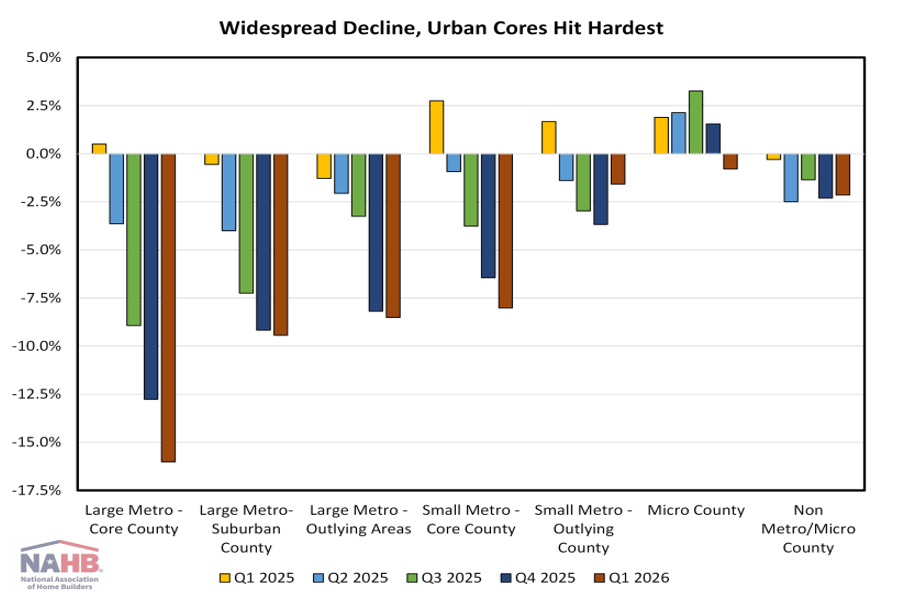
Single-family construction declined across all geographies in the first quarter of 2026, according to the latest Home Building Geography Index...
1 min read
Market selection is becoming increasingly important for multifamily investors in 2026. FSF shares commentary on Arbor’s Spring 2026 Multifamily...